Is Your Senior Dog Anxious at Night? Read This Before You Worry
🐾 Senior Dog Behavior
June 2026
·
10 min read
Is Your Senior Dog Anxious at Night? Read This Before You Worry
✅
Information in this article references guidance from:
American Kennel Club (AKC.org), PetMD.com, and VCA Animal Hospitals.
Always consult a licensed veterinarian if your senior dog's anxiety is
affecting their quality of life.

That look in your senior dog's eyes at night — restless, uncertain,
unable to settle — almost always has an identifiable cause. And most of
those causes respond well to the right management approach. (Photo:
Pexels)
Quick Answer: Nighttime anxiety in senior dogs is most
commonly caused by Canine Cognitive Dysfunction (CCD),
chronic pain, sensory loss (vision or
hearing), or
separation anxiety that has intensified with age. PetMD
identifies anxiety in senior dogs as a manageable condition — not an
inevitable part of aging. Treatment depends on the cause and may include
prescription medication (trazodone, fluoxetine), calming supplements
(Purina Calming Care, Zylkene), pheromone diffusers, and environmental
changes. A vet visit to identify the underlying cause is always the first
step.
The household has settled for the night. You're finally in bed. And then
it begins — your senior dog pacing, whining, unable to find a comfortable
spot, or pressing against you with that look of low-level distress that
you can't quite name but can't ignore.
Senior dog nighttime anxiety is exhausting for everyone in the house. And
it can feel particularly heartbreaking because your dog can't tell you
what's wrong — only that something is.
The good news: in most cases, there is something identifiable driving this
behavior. And in most cases, it can be meaningfully reduced with the right
combination of diagnosis, medication, and home management.
How to Recognize Nighttime Anxiety in Senior Dogs
Anxiety in senior dogs doesn't always look like obvious distress. PetMD
notes that the signs can be subtle — particularly in stoic dogs — and may
be mistaken for general aging or restlessness. Recognizing the pattern is
the first step to getting help.
📝 Scenarios shared throughout this article represent common situations
reported by pet owners and are used for illustrative purposes.
Common Signs of Nighttime Anxiety
😰 Pacing or circling — unable to settle in one spot
for more than a few minutes
😮💨 Panting at rest — without heat or exercise as a
cause
🗣️ Whining, crying, or barking — especially if new or
increasing in frequency
👀 Restless scanning — eyes darting, alert to nothing
specific
🤝 Excessive clinginess — following owner room to room,
unable to be alone
😤 Panting or yawning — calming signals indicating
stress
🌙 Worse at night than during the day — a key indicator
of several specific causes
💤 Sleeping more during the day — day/night reversal
pattern
💡 Record a video. VCA Animal Hospitals recommends
recording your dog's nighttime behavior before your vet appointment. Dogs
often behave differently in the clinic environment, and a video gives your
vet invaluable context — especially for behaviors that occur specifically
at night.
5 Causes of Nighttime Anxiety in Senior Dogs
This is the most common cause of nighttime anxiety in senior dogs. VCA
Animal Hospitals explains that CCD disrupts the normal sleep-wake cycle,
causing dogs to sleep heavily during the day and become confused,
restless, and anxious at night. PetMD notes that this pattern mirrors
"Sundowner syndrome" — a phenomenon in humans with dementia where
confusion and agitation worsen as the day ends.
Dogs with CCD may not understand where they are, where you are, or what
time it is. Being alone in the dark without the visual and auditory cues
that anchor them during the day can trigger significant distress. The
anxiety is not deliberate — it's the product of a brain that is
struggling to orient itself.
💬 Common Owner Experience
A pattern PetMD vets describe frequently: a senior dog begins waking
between 10 PM and 2 AM, pacing the bedroom, appearing confused when the
owner speaks to them, and eventually settling only when placed right
beside the owner's bed. The behavior is worse on nights when the dog has
slept heavily during the afternoon. A vet evaluation confirms CCD.
Selegiline — a prescription medication available only through a licensed
veterinarian — combined with night lights and a more active daytime
schedule produces significant reduction in nighttime episodes within 4–6
weeks.
💡 Key distinction: CCD-related anxiety tends to worsen
progressively over weeks and months, is often worse in the dark or
evening, and is accompanied by other cognitive signs (disorientation,
house soiling, changes in social interaction). Anxiety that came on
suddenly, or is isolated to specific triggers, suggests a different
cause.
Pain and anxiety are closely linked in senior dogs — and nighttime often
makes pain worse. When a dog lies still for extended periods, arthritic
joints stiffen. The discomfort of trying to reposition, or of finding no
comfortable position at all, drives restlessness that looks like
anxiety. PetMD identifies pain — from arthritis, dental disease, spinal
conditions, or other sources — as one of the primary medical causes of
nighttime anxiety in senior dogs.
The AKC notes that some dogs show almost no signs of pain during the day
when they're distracted and moving, but become visibly distressed at
night when the stimulation drops away and there's nothing to focus on
but how they feel.
💬 Common Owner Experience
A scenario VCA Animal Hospitals describes regularly: an owner attributes
their arthritic senior dog's nighttime restlessness to anxiety or
cognitive decline. A thorough vet assessment reveals the pain management
plan has become inadequate over time — the NSAID dose that worked a year
ago is no longer sufficient for the dog's current level of arthritis.
After adjusting to a prescription pain management regimen, the nighttime
restlessness resolves within two weeks. VCA emphasizes that pain should
always be evaluated before concluding nighttime anxiety is purely
behavioral or cognitive in origin.
Senior dogs that are losing their vision or hearing rely more heavily on
their remaining senses to feel safe. At night, when visual cues drop
away, a dog with deteriorating vision may feel genuinely disoriented and
unsafe — triggering anxiety. VCA notes that underlying illness or pain,
as well as sensory changes, can alter a senior dog's perception of their
environment in ways that heighten fear responses.
Hearing loss creates a different pattern: sounds that the dog once
learned to categorize as non-threatening — the refrigerator cycling on,
traffic outside, other household sounds — may now be startling or
confusing because the dog can no longer fully process them. This can
produce a vigilant, anxious state that makes settling for sleep very
difficult.
💬 Common Owner Experience
A pattern described in AKC behavioral guidance: an owner notices their
senior dog is calm during daylight hours but becomes increasingly
restless after dark, seeming to startle at sounds and unable to find the
safe spots they normally seek out. A vet evaluation identifies
significant vision loss. After adding night lights throughout the
sleeping area and confining the dog to a smaller, well-lit space at
night, the anxiety reduces substantially. The AKC notes that
accommodation of sensory loss — rather than trying to treat "anxiety"
directly — often produces the most meaningful improvement.
The AKC notes that anxiety in senior dogs can be associated with
cognitive dysfunction — but it can also arise independently from
age-related changes that make dogs less confident and more dependent on
their owners for security. PetMD estimates that 14–20% of all dogs have
separation anxiety, and this can worsen as dogs age and their cognitive
and sensory function declines.
An older dog that was comfortably independent at age 5 may become
significantly more anxious about being alone — or even in a different
room — at age 12 or 13. At night, when owners are asleep and less
interactive, this separation distress can emerge as whining, panting, or
persistent attempts to wake the owner.
💬 Common Owner Experience
A scenario PetMD vets describe: a senior dog that has slept peacefully
in a different room for years begins whining at the bedroom door every
night. The owner assumes cognitive decline. A vet assessment rules out
significant CCD and identifies intensified separation anxiety —
exacerbated by the dog's reduced vision making the nighttime separation
feel less safe. Moving the dog's bed into the bedroom resolves the
nighttime whining almost immediately. PetMD notes that proximity to the
owner is often the simplest and most effective first intervention for
separation-related nighttime anxiety in senior dogs.
Several medical conditions can produce nighttime restlessness and
anxiety as a symptom. PetMD lists conditions including hypothyroidism,
Cushing's disease, urinary tract infections, kidney disease, and heart
conditions as important causes to rule out before concluding that
nighttime anxiety is behavioral or cognitive in origin.
Conditions that increase the urge to urinate — UTIs, kidney disease,
diabetes — may cause nighttime distress as the dog needs to go outside
but is unable to communicate this effectively, particularly in older
dogs with reduced mobility or cognitive clarity. Heart disease can cause
breathing discomfort at rest that produces anxiety.
💬 Common Owner Experience
A scenario vets at VCA and PetMD describe frequently: a senior dog
develops sudden nighttime anxiety alongside increased water intake.
Blood work reveals hypothyroidism — a condition whose symptoms include
restlessness, anxiety, and metabolic changes that can disrupt sleep.
After starting thyroid medication — a prescription available only
through a licensed veterinarian — the nighttime anxiety resolves within
several weeks. PetMD and VCA both emphasize that blood work and
urinalysis are essential early in any workup for nighttime anxiety in a
senior dog.
When and How to Talk to Your Vet
Any new onset of nighttime anxiety in a senior dog warrants a vet
appointment — not because every case is serious, but because identifying
the cause is essential to choosing the right solution. A calming
supplement won't help a dog whose anxiety is driven by pain. Night lights
won't help a dog whose anxiety is driven by hyperthyroidism.
🚨 Seek Same-Day Care If Anxiety Is Accompanied By:
- Rapid or labored breathing alongside restlessness
- Collapse or sudden inability to stand
- Pale, gray, or blue gums
- Extreme distress — crying out, shaking uncontrollably
- Sudden onset rather than gradual development
- Straining to urinate with little output
For gradually developing nighttime anxiety without emergency signs,
schedule a vet appointment within the next few days. Come prepared with:
-
✅A video of the nighttime behavior — VCA recommends
this for any behavioral concern; it provides irreplaceable context
-
✅A timeline — when
it started, whether it's getting worse, what time of night it occurs
-
✅A complete list of medications and supplements — some
medications cause restlessness as a side effect
-
✅Notes on other behavioral changes — appetite, daytime
sleep, house soiling, social changes
-
✅A fresh urine sample — collected within 2–4 hours,
refrigerated; rules out UTI quickly
Medication and Supplement Options
Prescription Medications
PetMD identifies several medications vets may prescribe for senior dog
nighttime anxiety, depending on the underlying cause:
-
✅Selegiline (Anipryl) — the only FDA-approved treatment
for CCD-related behavioral signs. Helps regulate neurotransmitter
function and may reduce nighttime restlessness. Prescription only
through a licensed veterinarian; requires a washout period before some
other medications can be used.
-
✅Trazodone —
commonly prescribed for anxiety and sleep disturbance in senior dogs.
PetMD notes it may be used for CCD-related anxiety, though it cannot be
given simultaneously with selegiline. Prescription only through a
licensed veterinarian.
-
✅Fluoxetine (Prozac) — an SSRI that may help with
generalized anxiety and separation anxiety in dogs. The AKC notes it is
occasionally prescribed for dogs with anxiety disorders. Prescription
only through a licensed veterinarian; takes 4–6 weeks to reach full
effect.
-
✅Gabapentin —
commonly used when pain is a contributing factor to nighttime
restlessness; also has some anxiolytic effects. Prescription only
through a licensed veterinarian.
Supplements With Evidence
-
✅Purina Pro Plan Calming Care — a probiotic-based
supplement that PetMD mentions as a calming aid for dogs. Contains
Bifidobacterium longum, shown in a Purina study to reduce anxious
behavior. Available over the counter.
-
✅Zylkene (alpha-casozepine) — derived from milk
protein; PetMD notes it may reduce anxiety and fear responses in dogs.
Available over the counter; designed for daily or situational use.
-
✅Melatonin — may
help regulate the disrupted sleep-wake cycle associated with CCD. PetMD
mentions it as one of several options vets may suggest. Always confirm
dosing with your vet — some human formulations contain xylitol, which is
toxic to dogs.
-
✅Adaptil (Dog Appeasing Pheromone) — a synthetic
pheromone that mimics the calming signals nursing mothers produce.
Available as a diffuser, collar, or spray. VCA lists pheromone products
as a useful adjunct to other treatments for anxiety in senior dogs.
⚠️ Always discuss supplements with your vet first. Some
supplements interact with prescription medications — particularly
melatonin with certain cardiac drugs, and alpha-casozepine with some
sedatives. "Natural" does not mean interaction-free, especially for senior
dogs on multiple medications.
Home Management Strategies That Work Tonight
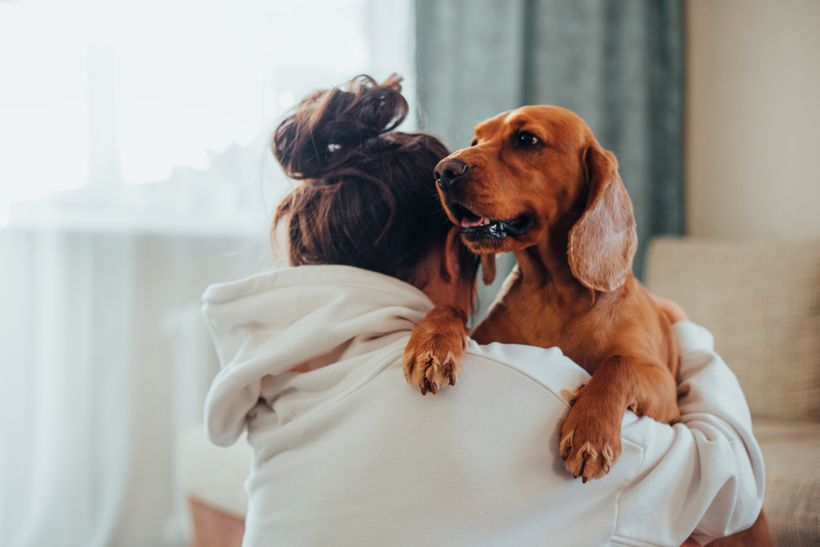
Your calm, consistent presence is one of the most powerful tools for a
senior dog with nighttime anxiety — and many of the most effective home
strategies cost nothing at all. (Photo: Pexels)
While you work with your vet on the underlying cause, these home
strategies can meaningfully reduce nighttime anxiety starting tonight:
-
✅Move your dog's bed into your bedroom. PetMD
identifies proximity to the owner as one of the most effective
interventions for separation-related and CCD-related nighttime anxiety.
Your scent, breathing, and presence provide real comfort — particularly
for a dog whose cognitive or sensory capacity is declining.
-
✅Add night lights throughout sleeping areas. PetMD and
the AKC both recommend night lights for senior dogs with vision loss or
CCD — reducing the darkness that triggers disorientation and anxiety.
Simple plug-in night lights in the bedroom and hallway are often
sufficient.
-
✅Increase daytime activity. PetMD recommends that
senior dogs with nighttime anxiety have more mental and physical
activity during daylight hours — gentle walks, puzzle feeders, brief
training sessions. A more active day promotes more restful sleep at
night and helps reset the disrupted sleep-wake cycle of CCD.
-
✅Maintain a strict consistent routine. PetMD emphasizes
routine as one of the most important tools for a dog with CCD or
age-related anxiety — consistent feeding times, walk times, and bedtime
reduce the number of unknowns the dog's impaired brain must navigate.
-
✅Try a pressure wrap (Thundershirt). Gentle, sustained
pressure has a calming effect on some anxious dogs — similar to
swaddling in human infants. The AKC notes that pressure wraps like
Thundershirt may reduce anxiety in some dogs, particularly for
situational anxiety. Worth trying for dogs whose anxiety doesn't have a
clear single trigger.
-
✅Use a white noise machine or calming music. Consistent
background noise can mask startling sounds that may be triggering a dog
with hearing loss. Classical music and species-specific calming music
(such as Through a Dog's Ear) have been shown in some studies to reduce
anxiety in dogs.
-
✅Provide an orthopedic bed in a warm spot. If pain is
contributing to nighttime restlessness, a memory foam or orthopedic bed
placed in a consistently warm, draft-free area reduces joint stiffness
and the discomfort of repositioning during the night.
-
✅Never punish or express frustration. PetMD is clear:
nighttime anxiety is not misbehavior — it's distress. Punishing an
anxious dog increases stress and worsens the underlying anxiety. Respond
with calm reassurance, then work on addressing the cause.
Frequently Asked Questions
Q: Why did my senior dog suddenly start being anxious at night?
Sudden onset nighttime anxiety is worth taking seriously — it suggests a
new cause rather than gradual aging. PetMD notes that underlying medical
conditions including UTIs, hypothyroidism, Cushing's disease, and pain
can all produce sudden-onset nighttime anxiety. A vet appointment with
blood work and urinalysis within the next few days is appropriate. Don't
assume it's "just cognitive decline" without ruling out treatable
medical causes first.
Q: Should I let my anxious senior dog sleep in my bed?
This is a personal decision — but from a purely behavioral standpoint,
proximity to the owner is one of the most effective tools for nighttime
anxiety in senior dogs, particularly those with CCD or separation
anxiety. PetMD notes that your presence provides genuine comfort, not
just distraction. If sleeping in the bed isn't possible or comfortable,
moving your dog's bed to the floor beside yours accomplishes much of the
same effect.
Q: My senior dog is anxious at night but fine during the day — what does
that mean?
A day-night pattern of anxiety points strongly toward CCD (which causes
sleep-wake reversal), vision loss (which worsens in low light), or pain
that builds up with inactivity during the night. The AKC notes that this
specific pattern — fine during the day, anxious at night — is one of the
most distinctive features of cognitive dysfunction. It's worth
discussing with your vet alongside blood work and a neurological
assessment.
Q: Can anxiety medication help my senior dog sleep through the night?
Yes — when the medication is matched to the cause. Trazodone may help
with sleep disturbance and anxiety; selegiline may reduce CCD-related
nighttime restlessness; pain medications may resolve anxiety driven by
chronic pain; thyroid medication may resolve anxiety driven by
hypothyroidism. The key is identifying the correct cause first — giving
a calming supplement to a dog whose anxiety is driven by pain will not
help. Always work with your vet to identify and address the root cause.
Q: How do I know if my dog's nighttime anxiety is from dementia or pain?
PetMD acknowledges this is genuinely difficult to distinguish from
behavioral observation alone — both can produce identical-looking
nighttime restlessness. Clues that suggest pain: the dog seems to be
position-seeking, resists lying down, responds to touch around specific
areas, or shows obvious stiffness. Clues that suggest CCD: the dog
appears disoriented, doesn't recognize familiar rooms, has a clear
day-night reversal of activity. In many senior dogs, both are present
simultaneously — which is why a full vet evaluation including blood
work, physical exam, and possibly imaging is more informative than
trying to distinguish them at home.
📚 Sources & References
-
PetMD —
Common Behavior Changes in Your Senior Dog and How You Can Help
— Lauren Adelman, DVM; Updated February 4, 2026
-
PetMD —
Dog Anxiety: Signs, Causes, and Treatment
— Updated June 2025
-
PetMD —
What to Know About Calming Aids for Dogs
-
American Kennel Club —
Anxiety in Dogs: Signs, Symptoms, and Treatment
-
American Kennel Club —
Dementia in Dogs: Signs, Symptoms, and Treatments
— Dr. Sagi Denenberg, Veterinary Behaviorist
-
VCA Animal Hospitals —
Fears, Phobias, and Anxiety in Cats and Dogs
-
VCA Animal Hospitals —
Behavior Counseling: Senior Pet Cognitive Dysfunction
The Bottom Line
Nighttime anxiety in a senior dog is not something to accept or push
through indefinitely. It is exhausting for you, and it is genuinely
distressing for your dog. But it is also, in most cases, something that
responds to the right intervention.
The path forward is always the same: identify the cause, then match the
solution to it. A vet appointment, a video of the behavior, and honest
discussion of everything you're seeing is the starting point. From there,
the combination of the right medication or supplement, thoughtful home
modifications, and your consistent, calm presence can turn difficult
nights into manageable ones — and manageable ones into good ones.
Your dog doesn't choose to be anxious at night. Help them feel safe enough
to rest.
Medical Disclaimer: This article is written for
informational and educational purposes only and does not constitute
veterinary medical advice, diagnosis, or treatment. Always consult a
licensed veterinarian before starting any medication or supplement for
your senior dog's anxiety.


Comments
Post a Comment