Is Your Senior Dog Breathing Fast While Sleeping? Read This Before You
Panic
🐾 Senior Dog Health
June 2026
·
9 min read
Is Your Senior Dog Breathing Fast While Sleeping? Read This Before You
Panic
✅
Information in this article references guidance from:
American Kennel Club (AKC.org), PetMD.com, and VCA Animal Hospitals.
Always consult a licensed veterinarian for your pet's specific health
needs.

Watching a sleeping dog breathe quickly can be alarming — but the number
that matters is simple: more than 30 breaths per minute consistently at
rest is the threshold vets use to assess concern. (Photo: Unsplash)
Quick Answer: According to VCA Animal Hospitals, a normal
sleeping/resting breathing rate for dogs is
15–30 breaths per minute. Rates consistently above 30
breaths per minute while resting or sleeping are considered abnormal and
warrant a veterinary call — particularly in senior dogs, where fast
resting breathing is one of the earliest signs of heart failure. Some fast
breathing during sleep (dream-related twitching and movement) is normal
and resolves quickly. Breathing that is consistently fast, labored, or
accompanied by other symptoms is not.
You woke up in the middle of the night and noticed your senior dog's chest
rising and falling faster than it should. Or maybe you've been watching
them sleep in the afternoon and something about their breathing doesn't
look quite right — too fast, too shallow, too effortful.
Your instinct to pay attention is correct. In senior dogs, changes in
resting or sleeping breathing rate are one of the most important early
warning signs of several serious conditions — including heart disease,
respiratory disease, and pain. At the same time, some fast breathing
during sleep is completely normal. Knowing the difference is what this
guide is about.
What Is a Normal Sleeping Breathing Rate for Dogs?
15–30
Breaths per minute — Normal resting/sleeping rate for all dogs
Source: VCA Animal Hospitals
VCA Animal Hospitals is explicit about this number: a normal breathing
rate while resting calmly or sleeping is between
15 and 30 breaths per minute — for all dogs, including
those with known heart disease that is well-controlled. Rates lower than
15 are not a concern as long as the dog is otherwise acting normally.
Rates consistently above 30 are considered abnormal.
15–30
✅ Normal
Normal resting/sleeping breathing rate. No action needed if dog is
comfortable.
30–40
⚠️ Monitor
Consistently above 30 — call your vet for guidance. Do not wait
several days.
40+
🚨 Urgent
Seek veterinary care promptly. Especially urgent if accompanied by
other symptoms.
An important nuance from VCA: breathing rates are normally
higher when dogs are hot, stressed, excited, or just finished
exercising — this is not a concern. The number that matters is the rate
when your dog is fully at rest or asleep in a calm, comfortable
environment. The sleeping rate is typically slightly lower than the
resting rate.
How to Measure Your Dog's Breathing Rate
VCA Animal Hospitals recommends this simple method:
-
✅Wait until your dog is sleeping or fully at rest in a
calm, comfortable environment — not hot, not excited, not just finished
playing.
-
✅Watch the chest. It rises and falls with each breath.
One breath = one complete rise and fall.
-
✅Count for 30 seconds using a watch or phone timer,
then multiply by 2 to get breaths per minute. Or count for a full 60
seconds.
-
✅Record the number. VCA recommends keeping a log — in a
notebook, calendar, or app — so you have a baseline to compare against
over time.
-
✅Count multiple times before concluding there's a
problem. VCA suggests counting several times over a few hours to confirm
the rate is consistently elevated, not just a momentary spike.
💡 VCA recommends: If your dog has known heart disease,
count their sleeping breathing rate once daily as part of routine
monitoring. An increase of more than 5–10 breaths per minute above their
established baseline — even if still under 30 — is worth reporting to your
vet.
When Is Fast Breathing an Emergency?
🚨 Go to an Emergency Vet Immediately If Your Dog Shows:
-
Breathing rate above 40 breaths per minute at rest, consistently
-
Labored breathing — visible effort, using abdominal
muscles to breathe, elbows out
-
Gums that are pale, gray, blue, or purple — this is a
critical emergency
-
Outstretched neck or refusal to lie down (trying to keep airway open)
- Coughing alongside fast breathing, especially at night
- Collapse or extreme weakness
- Fluid or foam from nose or mouth
-
Fast breathing that started suddenly in the last few
hours
PetMD states directly: "If your dog has an increased respiratory rate
(usually greater than 30 breaths per 60 seconds) when sleeping or resting,
this is a medical emergency; there may be an underlying issue with your
dog's lungs, heart, or airways."
6 Causes of Fast Breathing During Sleep in Senior Dogs
📝 Scenarios shared in this section represent common situations reported
by pet owners and are used for illustrative purposes.
Before assuming the worst, it's worth knowing that many episodes of fast
breathing during dog sleep are simply the result of dreaming. During REM
sleep, dogs can exhibit rapid breathing, twitching, paddling of paws,
vocalizing, and rapid eye movements — all of which are normal. The key
distinction: dream-related fast breathing is typically
brief (lasting seconds to a couple of minutes) and
self-resolving. The dog returns to normal breathing on their
own.
💡 How to tell: Dream-related fast breathing passes
quickly. If your dog's breathing returns to normal within 1–2 minutes
and they appear comfortable when they wake, dreaming is the likely
explanation. If the fast rate persists for longer or is there every time
you check, investigate further.
💬 Common Owner Experience
A pattern described frequently in veterinary practice: an owner notices
their senior dog's chest moving rapidly during sleep and becomes alarmed
enough to film it. The vet reviews the video and confirms the dog is in
active REM sleep — twitching, paddling, and breathing fast for about 90
seconds before settling back to slow, calm breathing. PetMD notes that
dream-related movement and breathing changes are normal across all life
stages, though they may become more noticeable in senior dogs who sleep
more deeply and for longer periods.
This is the most medically significant cause of consistently elevated
resting/sleeping breathing rate in senior dogs — and one of the most
important reasons VCA Animal Hospitals recommends monitoring it
regularly. When the heart's pumping efficiency declines, fluid can begin
accumulating in or around the lungs. The lungs' reduced capacity to
exchange oxygen causes the dog to breathe faster to compensate.
VCA notes that an increase in sleeping breathing rate is one of the
earliest detectable signs that heart failure is developing or
worsening — often appearing before the dog shows obvious external
distress. This is why monitoring breathing rate at home is so valuable
for dogs with known heart disease.
💬 Common Owner Experience
A scenario VCA Animal Hospitals describes as one of the most important
in senior dog heart care: an owner with a dog diagnosed with early heart
disease has been monitoring sleeping breathing rate as their vet
instructed. One week, they notice the rate has climbed from a baseline
of 22 to consistently 34–36 breaths per minute. They contact their vet,
who adjusts the diuretic medication before the dog develops obvious
respiratory distress. VCA notes that catching this change early — before
the dog is acutely struggling — leads to significantly better outcomes
and often avoids emergency hospitalization.
⚠️ VCA states: Fast resting/sleeping breathing rate is
an early clue that heart failure may be developing. If your senior dog
has known heart disease and their rate rises above 30 — or increases
significantly from their established baseline — contact your vet the
same day, not at the next scheduled appointment.
Conditions affecting the lungs and airways — including pneumonia,
chronic bronchitis, pulmonary hypertension, and lung masses — can all
cause an elevated resting breathing rate by reducing the lung's ability
to efficiently exchange oxygen. PetMD notes that respiratory causes of
fast breathing at rest are always medically significant and require
prompt veterinary evaluation.
Senior dogs are more susceptible to respiratory infections, and lung
tumors — whether primary or metastatic — become more common with age.
Unlike heart failure, respiratory causes may also produce coughing,
abnormal breathing sounds, or changes in the character of the breathing
(noisy, high-pitched, or wheezy).
💬 Common Owner Experience
A pattern PetMD vets describe: a senior dog develops a gradually
increasing sleeping breathing rate over several weeks, alongside an
occasional cough the owner attributes to post-nasal drip. Chest X-rays
reveal a pulmonary mass. Early detection prompts further staging and a
treatment discussion. PetMD emphasizes that any persistently elevated
resting breathing rate in a senior dog — even without other obvious
symptoms — warrants chest X-rays as part of the initial workup.
Chronic pain — from arthritis, spinal disease, dental disease, or
internal conditions — can manifest as fast or shallow breathing, even
during sleep. The body's pain response triggers the autonomic nervous
system in ways that can increase respiratory rate. PetMD notes that dogs
breathing abnormally at rest or during sleep, when pain may be a factor,
should be evaluated — particularly if the dog also shows reluctance to
move, changes in posture, or unusual sleep positions.
💬 Common Owner Experience
A scenario vets describe: an owner notices their arthritic senior dog
breathing faster than usual during sleep and shifting positions
frequently, unable to find a comfortable rest. A vet assessment reveals
inadequately managed pain — the dog's arthritis medications had become
less effective over time. After adjusting the pain management plan, the
dog's sleeping breathing rate normalizes and they sleep more soundly.
VCA notes that changes in sleeping position and breathing pattern can
both be indirect signs of pain in senior dogs.
Sleep apnea — where breathing momentarily stops and then restarts during
sleep — is more commonly associated with brachycephalic breeds (Pugs,
Bulldogs, Boxers) but can occur in any dog, particularly with obesity or
upper airway changes that accompany aging. PetMD notes that sleep apnea
in dogs causes momentary breathing pauses, sometimes many times
throughout the night, which can be followed by a sudden deep breath or
snort as the dog's body responds to the drop in oxygen.
💡 Watch for: Not just fast breathing, but
irregular breathing — pauses followed by catching-up breaths,
snorting, or gasping during sleep. PetMD advises: if you notice your
dog's gums look muddy or bluish during a sleep apnea episode, this is a
medical emergency requiring immediate veterinary attention.
Fever drives faster breathing as the body attempts to regulate
temperature. Anemia — a deficiency of red blood cells — causes rapid
breathing because the blood is less able to carry oxygen, so the dog
must breathe faster to compensate. Cushing's disease, hypothyroidism,
and other metabolic conditions can also affect breathing rate. PetMD
lists these as important causes to rule out during any workup for
abnormal breathing in a senior dog.
💬 Common Owner Experience
A pattern described in PetMD's guide to heavy breathing in dogs: a
senior dog develops an elevated sleeping breathing rate alongside pale
gums and reduced energy. Blood work reveals severe anemia from an
internal source of bleeding. Emergency treatment addresses the
underlying cause, and the breathing normalizes once the anemia is
treated. PetMD notes that pale gums alongside fast breathing always
constitute an emergency, as they indicate inadequate oxygen delivery
throughout the body.
What Your Vet Will Do
If your dog's sleeping breathing rate is consistently elevated, your vet
will typically begin with a structured assessment:
-
✅Physical exam including auscultation. Listening to the
heart and lungs with a stethoscope can immediately reveal murmurs,
abnormal heart rhythms, or abnormal lung sounds that suggest heart or
respiratory disease.
-
✅Chest X-rays. PetMD identifies chest X-rays as a
standard first step — they reveal heart enlargement, fluid in or around
the lungs, masses, and structural airway problems in a single image.
-
✅Blood work and urinalysis. These check for anemia,
infection, metabolic conditions, and organ function — important for
ruling out non-respiratory and non-cardiac causes.
-
✅Echocardiogram (heart ultrasound). If heart disease is
suspected, an echocardiogram provides detailed information about heart
structure, valve function, and pumping capacity — often performed by a
veterinary cardiologist.
-
✅Oxygen saturation monitoring. A simple clip-on sensor
checks how effectively the blood is carrying oxygen — a rapid,
non-invasive test that helps gauge urgency.
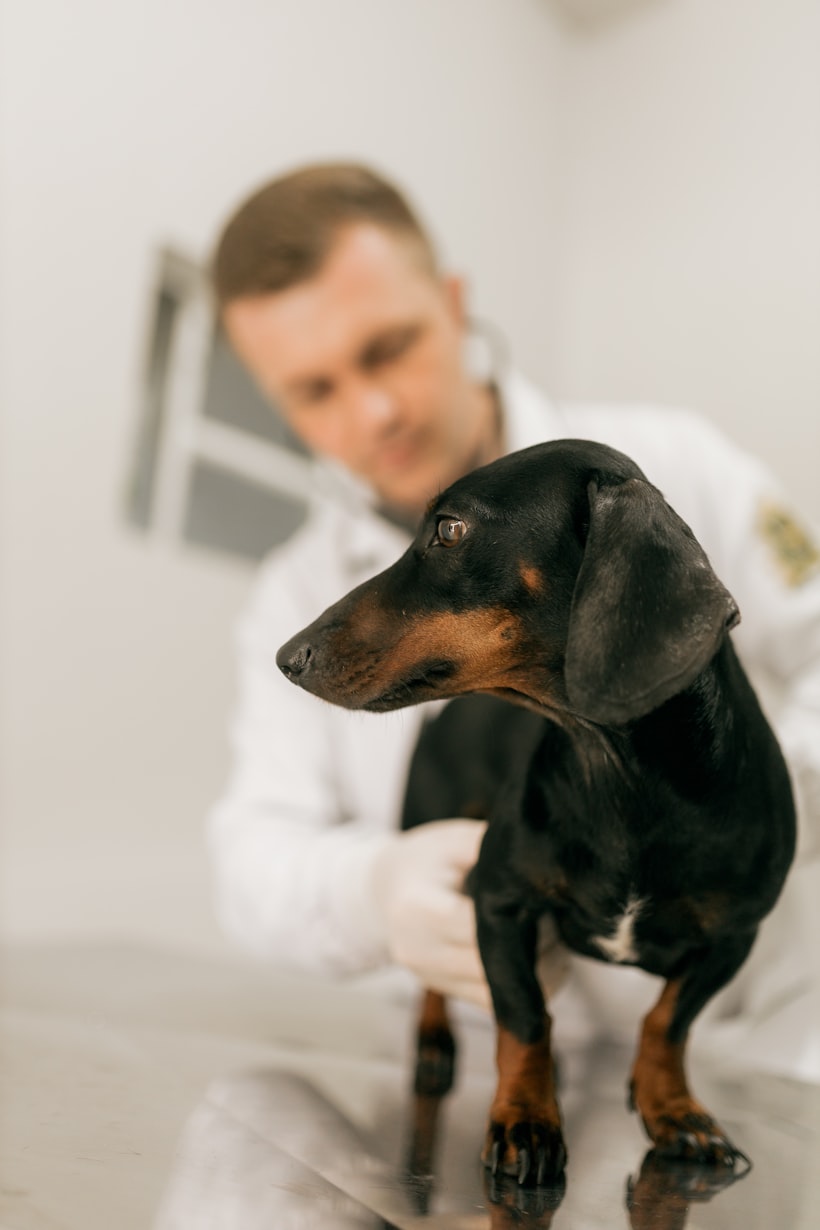
A stethoscope exam and chest X-rays are usually the first steps when a
senior dog shows a consistently elevated sleeping breathing rate — and
can identify heart or lung problems early, when treatment is most
effective. (Photo: Unsplash)
Frequently Asked Questions
Q: My senior dog is breathing fast in their sleep but looks comfortable
— should I still call the vet?
Yes, if the rate is consistently above 30 breaths per minute. VCA Animal
Hospitals emphasizes that an elevated sleeping breathing rate is an
important early warning sign — often appearing before a dog shows
obvious external distress. A dog can have early heart failure or early
respiratory disease and still look comfortable at rest. "Looking
comfortable" does not rule out a developing problem; the breathing rate
number is the key data point.
Q: What does normal fast breathing during sleep look like vs. abnormal?
Normal dream-related fast breathing is typically brief (lasting seconds
to 1–2 minutes), self-resolving, and often accompanied by other REM
sleep signs like twitching, paddling, or vocalizing. The dog's breathing
returns to a slow, calm rate on its own. Abnormal fast breathing is
persistent — it's there every time you check, it doesn't resolve
quickly, and may be accompanied by visible chest effort, changed
sleeping position, coughing, or gum color changes.
Q: How often should I monitor my senior dog's sleeping breathing rate?
VCA recommends once daily for dogs with known heart disease or other
respiratory conditions, and at minimum once or twice a week for healthy
senior dogs as a general health monitoring practice. Keep a written log
— even a simple notebook entry — so you can identify trends over time
and share specific numbers with your vet rather than trying to recall
them at an appointment.
Q: Can anxiety cause fast breathing in sleeping dogs?
Anxiety primarily causes fast breathing when a dog is awake — panting,
restlessness, and rapid breathing in response to triggers. However,
PetMD notes that anxiety and stress can contribute to difficulty
settling into deep sleep and may produce elevated resting breathing
rates. If your dog has a known anxiety condition and their sleeping
breathing rate is mildly elevated without other symptoms, mention it to
your vet — but don't assume anxiety is the explanation without ruling
out medical causes first.
Q: My senior dog's gums look pale alongside fast breathing — what do I
do?
Go to an emergency vet immediately. Pale, white, gray, blue, or purple
gums alongside fast breathing indicate the body is not getting adequate
oxygen — this is a critical emergency regardless of the time of day. Do
not wait until morning or until your regular vet is available. This
combination of symptoms requires same-hour emergency care.
The Bottom Line
Watching your senior dog breathe faster than normal during sleep is
unsettling — and it's right to take it seriously. The number to remember
is simple: more than 30 breaths per minute consistently at rest, even if
your dog looks comfortable, is a reason to call your vet. Not to panic —
but to call.
Many of the conditions that cause elevated sleeping breathing rate in
senior dogs — including early heart failure — are highly manageable when
caught before the dog is in obvious distress. The sleeping breathing rate
is one of the clearest windows into what's happening in your dog's heart
and lungs. Learning to monitor it is one of the most valuable things you
can do for an aging dog.
Start counting. Keep a record. Trust what you're seeing — and then let
your vet help you understand what it means.
Medical Disclaimer: This article is written for
informational and educational purposes only and does not constitute
veterinary medical advice, diagnosis, or treatment. If your dog is showing
signs of breathing difficulty, contact a licensed veterinarian or
emergency animal hospital immediately. Never delay seeking veterinary care
based on information in this article.


Comments
Post a Comment